
© 1364790498 / iStock
Polar bear population
How many polar bears are there? Are polar bears endangered? How is climate change impacting polar bears? These are common questions about the Arctic’s apex predator and its population status across the Arctic. Scientists have defined 20 distinct subpopulations of polar bears and have varying understandings of each subpopulation group.
Polar bears are extremely difficult for scientists to study. Accessing polar bear habitat is expensive and logistically challenging, such as tracking down polar bears in the vast and remote Arctic. In the 1960s and 1970s, scientists used surveys, capture and release, local knowledge and other methods to estimate polar populations. From the 1980s onwards, scientists have complemented these methods with satellite tracking and genetic data to better understand polar bear population estimates.
World polar bear experts come together to discuss the best estimates of polar bear populations through the IUCN Polar Bear Specialist Group, which was established in 1973. The latest polar bear status report from the IUCN Polar Bear Specialist Group was published in October 2024.
Conservation status of polar bear subpopulations
Less Arctic sea ice affects polar bears in many ways, including changes to bears’ physical condition, behaviours and survival rates.
Polar bears across the Arctic are experiencing the impacts of climate change differently. In the high Arctic, melting of thick, multi-year sea ice is resulting in more prey for polar bears, leading to temporarily stable and even improved conditions for the Kane Basin and M’Clintok Channel polar bear populations.
In other parts of the Arctic, sea ice is shrinking far too quickly for polar bears to adapt, and subpopulations are declining. For example, in the Southern Beaufort Sea, Western Hudson Bay and Southern Hudson Bay.
How the different subpopulations of polar bears respond to climate change is still unfolding.
However, a recent study shows that by 2100, even if we moderately reduce our greenhouse gas emissions, local extinctions of polar bears in some parts of the Arctic are likely. If we fail to reduce our emissions, by 2100 we may lose all but a few high-Arctic subpopulations in and around the Last Ice Area.
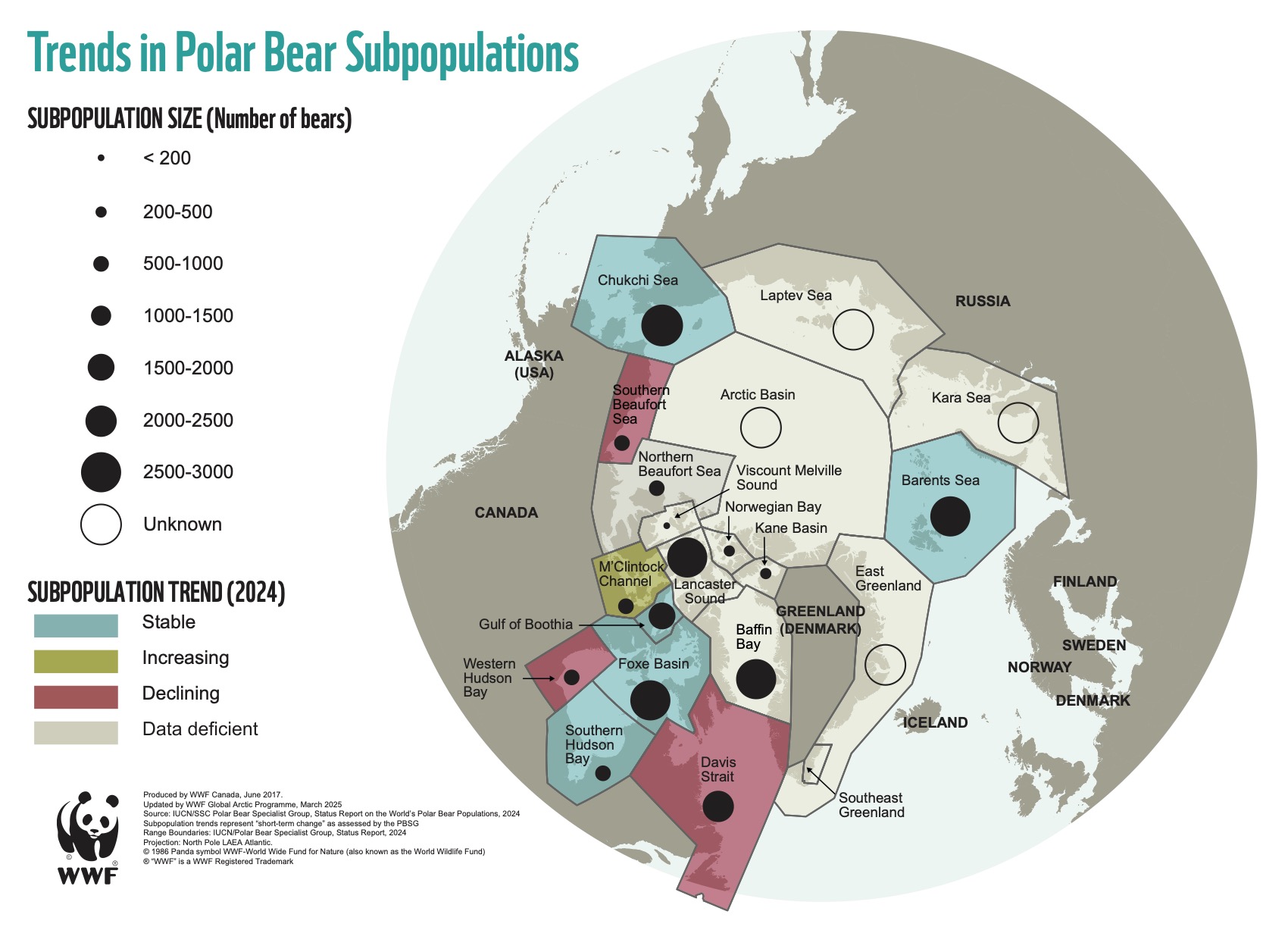
© WWF Global Arctic Programme

© Richard Barrett / WWF-UK
Conservation status by country
International: Vulnerable
Canada: Special Concern
Greenland/Denmark: Vulnerable
Norway: Vulnerable
Russia: Indeterminate, Rare, or Recovering, depending on subpopulation
United States: Threatened
More about polar bears


The latest on polar bears


Greenland,
Polar bear


Governance,
Last Ice Area,
Pan-Arctic,
Polar bear


Canada,
Climate Change,
Greenland,
Last Ice Area,
Norway,
Pan-Arctic,
Polar bear,
Russia

Canada,
Pan-Arctic,
Polar bear,
Russia,
United States